"The war revolutionised the industrial position of women - it found them serfs and left them free."
- Mrs Millicent Fawcett, leading feminist, founder of Newnham College Cambridge and president of the National Union of Women's Suffrage Societies from 1897 to 1918
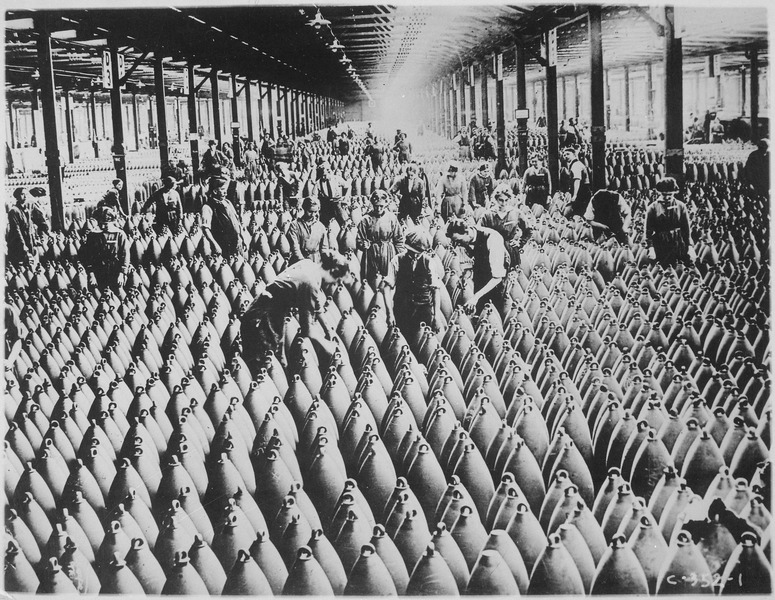

In the years 1914 to 1918 approximately two million women replaced me in employment resulting in the increase of 24% of women in work in July 1914 to 37% in November 1918.
In the prior years 11/13% of the female population of England and Wales worked as domestic servants, which then dropped to below 8% after the war.
Around 1,600,000 women joined the workforce during World War I in Government departments, public transport, the post office, as clerks in business, as land workers and in factories, especially in the dangerous munitions factories, which employed 950,000 women by Armistice Day (as compared to only 700,000 in Germany). Women in the Civil Service increased from 33,000 in 1911 to 102,000 by 1921. The advantages of this over domestic service was obvious: wages were higher, conditions better, and independence enhanced.
Female trade union membership also increased from 357,000 in 1914 to over a million by 1918 (a 160% increase), compared with an increase in men's unions membership of only 44%. However employers avoided wartime equal pay regulations by employing several women to replace one man, or by dividing skilled tasks into several less skilled stages. This way women could be employed at a lower rate as they weren't "replacing" men directly.
Many women were employed in munitions factories, who were popularly known as munitionettes. Munitionettes produced 80% of the weapons and shells used by the British Army and risked their lives daily, working with poisonous substances without the use of adequate protective clothing or the required safety measures.
Lots of women worked with the acid trinitrotoluene (TNT), which with prolonged exposure to it turned the women's skin a yellow colour. These women were often referred to as canary girls. The exposure to these chemicals also had long term health issues for the women.
On a few occasions the explosives that they worked with ignited, injuring or killing workers. For example, the 1917 Silvertown explosion, in which 73 people were killed and over 400 injured, and a 1918 explosion at the National Shell Filling Factory, Chilwell, which killed over 130 workers.
This can be seen as their will to sacrifice for Britain, although it also suggests that their labour was cheap and replaceable. Knowing this I can think about how the knowledge of women in the work place seeming somewhat inferior to men would affect my character. Also living with constant fear, of losing loved ones and working with such dangerous materials, it can suggest that I could add a slight edge to my character, as though she is always waiting for the next bad thing to occur. I do however realise the improved self belief these women may now have due to their ability to provide for themselves and their families independently.
Reference:
http://www.firstworldwar.com/features/womenww1_four.htm
http://en.wikipedia.org/wiki/Munitionettes
This video gives a really good image of what life was like for the munition workers.
http://www.britishpathe.com/video/women-munition-workers-1
In it you can see the women working hard and fast to produce shells and other artillery. It gives you an idea of the pace they worked at as well as the mass production as you witness the rows of machinery, each one manned by another woman.
Watching this video has given my ideas on how I can develop the way I can physicalise the beginning factory sequence and the types of movement that we could include. I also got an idea of how my character might move in her attire doing said movements and what kind of feelings she might have towards her work, after having witnessed the monotonous work they do day in day out.

No comments:
Post a Comment